
The federal Department of Environment says greenhouse gas emissions are up again in British Columbia, hailed by cabinet as a model for the federal carbon tax. The province on April 1 raised its provincial tax to $45 per tonne: “That is exactly what we know will work right across the country.”
Got Help From Paid Lobbyist
Heritage Minister Steven Guilbeault relied on claims from a lobbyist subsidized by his own department to counter criticism of a YouTube censorship bill. Guilbeault’s department approved a $375,000 grant to the lobby group Coalition for the Diversity of Cultural Expressions of Montréal prior to its endorsement of Bill C-10: “This is a huge issue.”
Labour Minister Made It Up
Labour Minister Filomena Tassi fabricated claims a “life and death” longshoreman’s strike at the Port of Montréal disrupted deliveries of pandemic medicine. The Department of Transport confirmed of thousands of shipping containers tied up at the Port not one contained vaccines: “Covid fearmongering is not a valid or compelling argument.”
1,400 Covid Carriers By Air
About 1,400 Covid carriers arriving in Canada by international flights were unwittingly released from hotel quarantine, says the Public Health Agency. Cabinet last February 22 ordered passengers into three nights’ quarantine at designated hotels under a $225.6 million program: “I’m wondering how this can happen.”
Calls Meth A Rural Scourge
Methamphetamine addiction has become a scourge in rural Canada, says a New Brunswick Senator. David Richards said the country has lost “a whole generation of kids” addicted to illegal drugs: “These kids are on the streets day and night with bolt cutters and hacksaws to break into places because they need a meth fix.”
“Shine Light” On Shell Co’s
Cabinet must “shine light” on the true owners of corporations registered in Canada, says Finance Minister Chrystia Freeland. Testifying at the Senate national finance committee, Freeland said cabinet was committed to creating a public registry of corporate owners that would be searchable by name: “Setting up a register is pretty complicated.”
Must Offer More Than Mail
Canada Post will expand services including “financial products” after suffering a record loss last year, says management. The corporation had a pre-tax loss of $779 million, the equivalent of more than $2 million a day, and saw almost half its 6,026 post offices operate in the red: “I think the word ‘banking’ scares a lot of people.”
“Stand On Guard For Thee”
Poet Shai Ben-Shalom, an Israeli-born biologist, writes for Blacklock’s each and every Sunday: “Takeover of Canadian resources by foreign governments must not be taken lightly. Contracts that transfer control over such assets should be written and signed…”
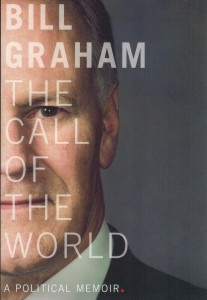
Review: The Third Man In The Room
On March 21, 2005 a small group of men attended a secret meeting in Ottawa and committed Canadian troops to a disastrous Asian land war. No minutes of the conference exist. None of the participants had been to Afghanistan; none spoke Farsi; none had been in combat. Three participants recalled the event in their memoirs. Two of these accounts, by then-Prime Minister Paul Martin and Chief of Defence Staff Rick “Hell-ya” Hillier, are of little use.
The third man was Bill Graham, then defence minister. Graham’s account from page 373 of his autobiography rates among the most profound writing of any postwar Canadian politician. Faced with a life and death decision, Graham chose unwisely. He admits it with humility and candour. To read The Call Of The World is to sense a nagging conscience and sleepless nights. “It’s a cautionary tale that future governments might do well to heed,” he writes.
Acting without parliamentary authority or debate, cabinet committed troops to combat in Kandahar, Afghanistan. The mission was so catastrophic the defence department for years concealed casualty figures, and apologists misled the country in claiming phantom victories. “The Taliban is on the run,” Stephen Harper said in 2006. Canadians were told Afghanistan was “on its way to becoming a high-functioning democracy” (Winnipeg Free Press) where “there is progress every day” (Legion Magazine) in what was “one of the most extraordinary success stories” (Barrie Examiner) in “start contrast to the claims of naysayers” (Saskatoon Star-Phoenix).
“One of the things that never ceases to amaze me is the Canadian government’s relentless effort to spin the war in Afghanistan into a positive light,” Scott Taylor of Esprit De Corps wrote in 2010. “Equally gobsmacking is the number of media flunkies who all too eagerly give voice to this misleading nonsense.” Esprit De Corps published a photo of then-Canadian Ambassador Chris Alexander next to a headline that read, “Only Village Idiot Can Remain Hopeful In Afghanistan”.
So, we come to Bill Graham’s memoirs. Graham is sincere and forthright. No, we didn’t know much about Afghanistan, he writes. No, we didn’t really know what we were doing. “No one in any department persisted in pointing out the pitfalls,” he writes.
“Nobody foresaw how large or long a commitment Canada was going to make to a country that was unknown to most Canadians and geographically far removed from any place that touched on our vital interests,” Call Of The World acknowledges. It exposed Canadian troops to a “violent, experienced enemy in very hostile terrain.”
“We were clearly and deliberately sending our men and women on a peacemaking mission in a dangerous conflict zone,” writes Graham. “What we underestimated was the scale, intensity and duration of the fighting that our troops would face.”
“I have to admit that some of the seeds of our disappointment should have been evident at the start,” Graham continues. “We knew much less about Afghanistan and the politics of the region than we should have”; It was unrealistic for us to expect that we could construct a truly effective government and civil society in the midst of the ongoing carnage. Moreover, our efforts to create an accountable, corruption-free and efficient police force capable of providing basic security for the population met with only modest, highly localized success.”
“We got into an extended conflict from which we couldn’t extract ourselves,” he concludes. Many questions remain: why was Parliament not consulted? What realistically did Canada intend to achieve? How would cabinet define mission failure? Graham kept notes but provides limited answers.
There’s a question of whether confessions of Call Of The World will reassure or infuriate war widows and those Canadians whose lives were forever altered by our Asian war. For the moment Graham deserves credit for plain honesty in a political memoir that breaks the mold of self-serving platitudes.
By Holly Doan
The Call Of The World: A Political Memoir, by Bill Graham; University of British Columbia Press; 456 pages; ISBN 9780-7748-90007; $39.95

Blitz MPs On Censor Bill C-10
An internet advocacy group yesterday blitzed MPs with thousands of protest emails over a cabinet bill to censor YouTube. Heritage Minister Steven Guilbeault said critics were confused: ‘He lied to us and inserted a Trojan Horse regulatory power over all user audiovisual content.’
Complainers Take Time: CEO
A federal air passenger rights regulator in a confidential letter to the airline lobby complained hearings on travelers’ complaints were “time consuming,” and proposed to “minimize the number of complaints” formally reviewed by the Canadian Transportation Agency. CEO Scott Streiner wrote the letter as 19,000 passengers contacted his Agency for help after being denied cash refunds for prepaid tickets: “I recognize how challenging and unprecedented this period is for the members of the National Airlines Council.”
Wrong Up To 13% Of Time
Taxpayers calling the Canada Revenue Agency may have a better than one in ten chance of getting bad advice, records show. The Agency has said it is not liable for costs incurred by tax filers who act on inaccurate information: “You’re the big machine.”
Was Oversubscribed By $1.6B
A federal loan program for small business has been oversubscribed by more than a billion, according to Department of Industry figures. Records show a quarter of applications for interest-free $60,000 loans were rejected, on average: “It was oversubscribed in the very first round.”
Waited To Report IT Breach
Languages Commissioner Raymond Théberge waited nearly two weeks to notify internet users of a privacy breach at his office. Staff mistakenly disclosed the IP addresses of more than 1,500 people who filed complaints with Théberge over a two-year period: “I have a responsibility.”
Work Is Secret But For Google
Paul Glover, the $273,000-a year head of a federal IT agency, yesterday said his work was so secretive he couldn’t comment on his own news releases. Glover invoked national security in refusing to tell Parliament the location of government data centres until MPs pointed out the street addresses were searchable on Google: “Are you serious?”