
The Department of Health in a 2006 pandemic master plan predicted even a mild outbreak would kill from 11,000 to 58,000 Canadians, see ten million others take sick days from work, and last a full year. The prophetic study predicted the pandemic would originate in Asia: “It is unlikely an effective vaccine will be available.”
Feds Eye Emergency Powers
Cabinet yesterday said it may invoke extraordinary measures under the Emergencies Act to stem the Covid-19 pandemic. “I did not expect to have it invoked in my lifetime,” said a former Conservative minister who wrote the law thirty-two years ago.
Biz Faces Ruin, Gov’t Warned
Thousands of small businesses already face ruin due to the Covid-19 pandemic, says a Canadian Federation of Independent Business survey. Cabinet said it will detail an aid package today: “We’ve never seen this before in Canada.”
Guilty Plea Brought Contract
SNC-Lavalin Group Inc. received another federal contract the very day it pleaded guilty to fraud, records show. The company was awarded $23.3 million in federal contracts in a year it spent awaiting trial: “Staggering.”
$23K For Smudge Complaint
A British Columbia landlord who asked an Indigenous tenant to stop smudging in the apartment has been ordered to pay $23,300 in damages. The tenant cited the 2015 final report of the Truth and Reconciliation Commission as evidence of system discrimination against First Nations: “The smoke cleanses negative energy.”
Feds Issue Covid-19 Decrees
Cabinet has approved an executive order naming Deputy Prime Minister Chrystia Freeland and Veterans Affairs Minister Lawrence MacAulay as successors in case the Prime Minister is incapacitated. Justin Trudeau has been in self-quarantine since March 12 when his wife Sophie was diagnosed with Covid-19: “This is not the time to quibble.”
24% Are Vaccine Skeptics
About a quarter of Canadians would not take a vaccine against Covid-19 even if it was available, suggests a Department of Health study. Researchers found a significant minority of people including parents are wary of vaccinations: “I don’t believe in them.”
Won’t Disclose Stock Losses
A federal agency that put a fifth of its parliamentary grant in the stock market yesterday would not disclose losses. The Canada Race Relations Foundation had millions in equity wiped out in the 2008 panic and was forced to cut staff salaries forty percent: “It was a huge impact.”
Arctic Sealing Now A Pastime
A European Union boycott has reduced Arctic seal hunting to a weekend pastime, says the Department of Fisheries. The Inuit commercial hunt is now entirely reliant on federal aid, wrote auditors: “Few hunters are hunting seals.”

Appointee Takes Red Junket
Canada’s chief librarian Leslie Weir in her first act in office last September 7 accepted a Communist Party-paid junket as guest of the National Library of China in a celebration of “socialist culture,” according to records. The Beijing conference was held only weeks before Party librarians admitted to book burning.
Weir did not reply to an interview request, and Library and Archives Canada did not comment. The former University of Ottawa librarian was named to the $243,000-a year post by cabinet last August 30.
Records indicate a week later Weir billed $983 in expenses to fly to Beijing as guest of China’s National Library in celebration of the seventieth anniversary of the Communist takeover of the mainland. Thousands in additional expenses were paid by her hosts. “Accommodation costs, meals and a portion of the air fare cost were paid by the National Library of China,” according to filings.
Weir’s visit to the two-day conference came nine months after Beijing police jailed two Canadian consultants, Michael Kovrig and Michael Spavor. A total 123 Canadians were in Chinese prisons at the time, according to the Department of Foreign Affairs.
Weir did not disclose a text of her speech to the conference of the International Symposium of Libraries. Only nine other countries sent delegates, according to minutes of the meeting.
The conference opened with remarks by China’s Minister of Culture who said he “hoped the National Library of China and public libraries around the country would stick to the Communist Party Central Committee’s decisions and plans…and make greater contributions to the great development and prosperity of socialist culture,” according to minutes.
Written greetings from Chinese President Xi Jinping “aroused prolonged and warm applause.” A statement by the Party-run Xinhua news agency read: “Xi Urges National Library To Stick To Correct Political Direction,” explaining Party leaders expressed “the hope that the Library will make new contributions to the building of a socialist country with great cultural strength.”

Party-run press only weeks after the librarians’ convention reported Chinese authorities in Gansu Province held a public book burning as part of a “thorough clean-up” of “illegal publications and religious publications, especially books, pictorial publications and visual content that showed leanings.”
The official Red Star News on December 6 reported the book burning complete with photo. The stories were later deleted by Party censors but confirmed December 9 by the South China Morning Post, a Hong Kong daily.
China’s Ministry of Education in an August 7 decree only weeks before the library convention issued new textbooks on “moral education.” “As a big improvement on previous versions, the textbooks have fully incorporated socialist traditions and values, traditional Chinese cultural expressions and China’s revolutionary history,” the ministry said in a statement.
By Staff 
OK Wartime Spending Power
Parliament has granted cabinet wartime spending powers for ninety days. The bill was introduced in the Commons at 10:15 am, sped through the Senate and was signed into law by 12:14 pm Friday amid fears of the coronavirus pandemic: “We do what it takes.”
The Navy Runs Out Of Parts
Canada’s submarine fleet has defective welds and diesel engines so obsolete the navy cannot find parts, says a newly-released audit. The entire fleet spent last year in dry dock at a cost of $325.5 million: ‘Obsolescence has made it difficult.’
No Case For Farm Tax Break
Cabinet has no “business case” to grant more carbon tax exemptions to farmers, says Agriculture Minister Marie-Claude Bibeau. Two private bills introduced in Parliament would extend multi-million dollar tax breaks for grain growers: “I want to question your data.”
‘Beyond Quantum’: A Poem
Physicists claim
nothing in nature
can be lost.
All changes
are merely transformations
of matter and energy.
Only in magic shows,
or works of fiction,
does anything evaporate
into thin air.
In the newspaper,
articles hint at a new branch of knowledge
when discussing the fate of public funds
in the hands of governments,
legislators.
(Editor’s note: poet Shai Ben-Shalom, an Israeli-born biologist, examines current event’s in the Blacklock’s tradition each and every Sunday).
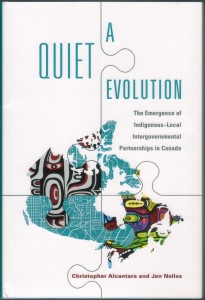
Book Review: Petty — And Profound
What do municipalities and First Nation reserves have in common? Both are used to being told what to do. It’s natural, then, that any review of Indigenous self-government would examine how these two get along at the most elemental level. A Quiet Evolution is the first research of its kind, and prompts the reader to wonder why nobody thought of this before.
It turns out relationships between cities and reserves can be petty or profound – human, in other words. If Parliament ever settles outstanding land claims and accepts Indigenous property rights nationwide, it would look something like this.
“It would be easy to conclude that the Indigenous-Crown relationship is almost entirely adversarial and problematic,” authors write. “While this pessimism is certainly pervasive and somewhat justified, given Canada’s history of colonialism, a much different story seems to be unfolding at this local level.”
Co-authors Prof. Christopher Alcantara is a political scientist at Western University; Jen Nelles is a visiting professor at Hunter College. They examined the fine print in local agreements between cities and First Nations, some 332 of them. “Willingness is key,” they write.
Some contracts are plain and practical. In Kamloops, B.C., the local band pays the city $437,000 a year plus overtime to contract fire protection for its 1,410 property owners. Economic self-interest makes for good neighbours, notes Quiet Evolution: “Indigenous and municipal authorities typically govern with relatively few resources particularly outside of the larger cities and settlements. Where local and Indigenous authorities have discretionary funds to support joint projects, cooperation will likely be easier to establish.”
Other relationships go deeper and are “much more interesting,” authors write. In the Québec municipality of Les Basque on the St. Lawrence River, councilors reached agreement with nearby Algonquians for joint property management specifically to ward off private ownership of prime lands. Each agreed to ante $120,000 and work it out. They did.
In Elliot Lake, Ont., the municipality has an agreement with the Serpent River First Nation on heritage planning and joint lobbying of the legislature. In The Pas, Man., they share costs of the local hockey team with the Opaskwayak Cree Nation. In Cape Breton, N.S., the regional municipality reached agreement with Membertou First Nation to build a highway and hotel on Indigenous lands.
“While national and provincial media publications are filled with stories of conflict, contention and demands, many Indigenous and local governments are quietly engaging in what seems to be highly productive and beneficial intergovernmental partnerships,” authors conclude.
The formula is not foolproof. “Rightly or wrongly, history has the potential to be a powerful barrier to cooperation,” Quiet Evolution cautions.
In Sault Ste. Marie, Ont., authors identified a grudging relationship between municipal managers and the local Garden River First Nation three kilometres outside of town. Former Buffalo Sabres head coach Ted Nolan is from Garden River; he used to coach the Sault Ste. Marie Greyhounds.
Ratepayers privately grumble about First Nations residents, and authorities refused to run a municipal bus route through the reserve when nobody could agree on how to pay for it. One Sault planner complained, without irony, that First Nations are bureaucratic. “The people you’re dealing with are not the people who have the ability to agree or disagree,” he sighed.
Quiet Evolution provides a glimpse of a future in which Indigenous communities are partially self-governing economic units, like a thousand other towns. Some are good, and some are just good enough. It’ll work.
By Holly Doan
A Quiet Evolution: The Emergence Of Indigenous-Local Intergovernmental Partnerships In Canada, by Christopher Alcantara and Jen Nelles; University of Toronto Press; 159 pages; ISBN 9781-44262-6775; $32.95