A federal agency that disregarded employees’ appeals for religious exemptions from vaccine mandates breached the Charter Of Rights, a labour board has ruled. The National Research Council was cited for twice dismissing pleas from Christian staff who objected to the source of cells used in production of Covid shots: “The state is in no position to be, nor should it become, the arbiter of religious dogma.”
A Happy May Long Weekend
Blacklock’s pauses for the Victoria Day observance with warmest wishes to friends and subscribers. We’re back tomorrow — The Editor.
A Poem — “Bill 101 Quebec”
Translated into French
my short poems
aren’t so short after all,
if only due to the larger
font size.
By Shai Ben-Shalom 
Review — Rights Versus Grievances
In 2010 lawyers at the Department of Justice claimed a constitutional right to weekend golf getaways. They work a 37.5-hour week and spend the odd weekend on call, unpaid unless they actually attend court on Saturday. Attorneys complained that meant they couldn’t leave town or drink or host a dinner party when on call, in breach of their Charter right to life and liberty.
It took six years, two trials and two labour board rulings before a federal judge threw out the complaint as thin. Everybody has basic human rights, wrote Justice Yves De Montigny, “but not the right to do as you please in all circumstances.”
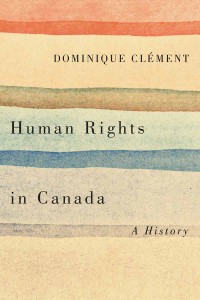
In Canada the cry of human rights is now applied to humdrum complaints. “Human rights is the language we use to frame the most profound – and the most commonplace – grievances,” writes Dominique Clément, association professor of sociology at the University of Alberta; “Human rights are not immutable. They are continually adapting as times change.”
Clément’s Human Rights In Canada: A History is a spirited and unconventional look at our distinctly Canadian rights culture. Discourse in other nations is framed by historical atrocities of slavery or the Holocaust, of evil and goodness. In Canada it runs the gamut from the profound to the mundane.
“Although rights are a moral claim, it is misleading to suggest they are based on universal truths,” Clément writes. “In fact, human rights have an instrumental or political function. People frame their grievances and their vision for social change using the language of rights.”
If Québec clearly breached the rights of Jehovah’s Witnesses to practice their faith in the 1950s, Human Rights notes: “It is easy to understand why Jehovah’s Witnesses were bitterly disliked in the vastly Catholic province”; “They distributed pamphlets on the streets and made unsolicited visits to people’s homes where they described the Catholic Church as the ‘whore of Babylon.’”
There is a historical thread here. Well, more of a squiggle. What if any connection draws Alberta Hutterites’ historic fight to buy farmland with same-sex marriage; or votes for Caucasian women but not Indigenous ones; or an 1885 federal ban on the Plains tribes’ Sun Dance?
“Each society determines the nature and implementation of rights in practice,” Clément writes. “This process, however, is highly contested. The history of human rights is not a linear process of new rights claims but rather a history of defending existing rights. My primary argument is that human rights are always contested, but the nature of human rights is such that they invariably lead to new rights claims.”
Nor is every rights claim an explicit conflict between privilege and the oppressed, Human Rights notes. “People with privilege have appropriated rights discourse for their own interests.”
Throughout his writing Clément cites intriguing facts that underscore his point that “rights” are contested and rarely clear-cut, and part of the clamor of democracy itself. MPs may have unanimously passed Prime Minister John Diefenbaker’s 1960 Bill of Rights, but the Bill was useful in striking only one discriminatory law by 1982.
Human Rights argues that more profound was Diefenbaker’s 1959 refusal to dispatch RCMP to break up a paper mill strike in Newfoundland & Labrador. Members of the International Wood Workers struck for a reduction in their 60-hour work work, a 25¢ raise to $1.30 an hour, and cold running water in the bunkhouses. Newfoundland responded by dissolving the union, outlawing secondary picketing and demanding that Mounties round up strikers.
Not a chance, Diefenbaker told the Commons: “Newfoundland has greatly aggravated the present situation in that province by intervening in a labour dispute in a way which apparently goes against the usual role of government.”
It is a long reach from Newfoundland loggers to federal lawyers’ golf getaways. Human Rights makes it an intriguing journey.
By Holly Doan
Human Rights In Canada: A History, by Dominique Clément; Wilfrid Laurier University Press; 243 pages; ISBN 9781-7711-21637; $24.99
Had To Dump Stock Portfolio
Liberal MP Nathaniel Erskine-Smith (Beaches-East York, Ont.) hurriedly sold his stock portfolio in anticipation he’d remain in cabinet, according to a May 1 ethics filing made public yesterday. Erskine-Smith, a former corporate lawyer, did not detail which shares he sold days before being dropped as housing minister: “It’s impossible not to feel disrespected.”
Says Disclosure Cannot Wait
Taxpayers should not have to wait as late as December to see a federal budget, Opposition Leader Pierre Poilievre said yesterday. Cabinet is postponing disclosure of federal accounts until it finalizes a Fall Economic Statement similar to a document tabled last year on December 16: “It means spending is out of control.”
House Could Hang On 1 Vote
Ballot errors in a single riding threaten the legitimacy of any close votes in the 45th Parliament, Bloc Québécois leader Yves-François Blanchet said yesterday. The Party is contesting its loss of the Terrebonne riding to Liberals by a single vote on judicial recount after Elections Canada confirmed a Bloc ballot was improperly rejected: “It might make a difference in a very important vote.”
‘All Canada Was My Patient’
Dr. Theresa Tam, the nation’s $324,000-a year chief public health officer, considered “all Canadians as my patients” during the pandemic and resented public criticism that strayed into mockery of her accent and ethnicity. Tam’s views are detailed in Access To Information notes disclosed by the Public Health Agency: “Overnight I went from being relatively unknown to being broadcast to the public eye.”
Bill OKs Palestine Statehood
Legislation drafted by the National Council of Canadian Muslims would see Parliament recognize a state of Palestine. MPs who have advocated for recognition include a current member of cabinet: ‘It is model legislation.’
Budget Is Delayed Six Months
There will be no federal budget until the fall, Finance Minister François-Philippe Champagne said yesterday. Cabinet in the meantime will table a Ways And Means Motion proposing a multi-billion dollar income tax cut once Parliament resumes May 26, he said: “I could not be clearer than that.”
Davies Cursed Floor Crossers
Cabinet yesterday said it welcomed any opposition MP who wants to vote with the Liberal caucus in the minority 45th Parliament. New Democrat leader Don Davies earlier expressed outrage over floor crossing and sponsored a private bill to ban the practice: “The only people who have the right to determine which party represents them in the House of Commons are the voters themselves.”
Words Don’t Hurt Me: Fraser
Attorney General Sean Fraser yesterday dismissed questions regarding his competence. Opposition MPs depicted Fraser as a serial bungler who mismanaged two previous portfolios, housing and immigration: “It really doesn’t bother me too much.”
Housing Minister Number 5
Solving the nation’s housing crisis will be slow and complex, Housing Minister Gregor Robertson said yesterday. The former Vancouver mayor, the fifth federal housing minister in six years, told reporters he was uniquely qualified: “I am here to leverage my history.”
OK For Saturday Morning TV
Rough sports are suitable for Saturday morning TV providing there’s a viewer advisory, national broadcast regulators ruled yesterday. The decision followed complaints Sportsnet Central broadcast a bloody mixed martial arts match at 9:30 in the morning: “As a formal sport, mixed martial arts may appear to an uninitiated watcher to be something of a free for all.”
Eighth Appointee Since 2019
Liberal MP Shafqat Ali (Brampton-Chinguacousy Park, Ont.), a former realtor once cited for attending Parliament by videoconference from a men’s toilet, yesterday was named President of the Treasury Board. The Board presidency previously rated a senior position has seen eight appointees since 2019: “The Member of Parliament was literally using the washroom while participating in a sitting of the House of Commons, the cathedral of Canadian democracy. I can’t believe I actually just said those words.”