
Nobody’s published an anthology of celebrity draft dodgers though there are many: William Lyon Mackenzie King, Pierre Trudeau, Bill Clinton. Robert Menzies, the Australian prime minister, as a law student enthusiastically joined his campus militia unit but declined to fight overseas in the First World War. Menzies for decades afterward faced Opposition jibes that the war had interrupted his military career. Boxer Jack Dempsey took work as a longshoreman with a draft deferment. As heavyweight title holder, “reference to the new champion as a fighter often elicited sneers about the kind of fighting he had done in previous years,” historian Joseph Furnas wrote in 1974.
None of the personalities in Crossing Into Canada are celebrities. They would not even publish their surnames. One declined to be photographed. All came to Canada to evade U.S. military service. “Support for draft evaders and deserters during the war in Vietnam was not homogenous or guaranteed in Canada,” writes editor Alison Mountz. “Resistance was controversial then and remains so today.”
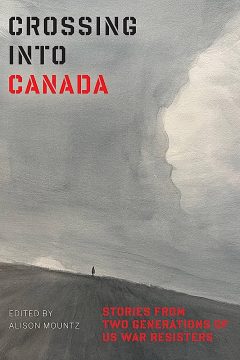
The University of Alberta Press compiled an oral history of draft dodgers. The subjects are neither heroic nor contemptible, but merely human. Crossing Into Canada is a lively collection of their stories, sometimes haunting, sometimes funny. Joe from Florida recalls his father telling him to buy a lumberjack shirt at Sears before defecting to Fredericton: “Look,” he said, “when you get up to Canada, you’re gonna have to blend in and look Canadian because who knows who’s going to be looking for you.”
“From Black Americans fleeing slavery to conscientious objectors fleeing participation in World Wars I and II, Canada has a long and complicated history as a safe haven for people leaving the United States,” writes Editor Mountz. Many Canadians of a certain generation “grew up knowing people in their communities – neighbours, teachers and community leaders – who came from the United States” in wartime, she writes.
Canadian readers gain the realization America’s military operates as a social safety net for the working poor who may not have weighed the implications of free tuition. “Going into the military was a financial decision,” says Linjamin, an Iraq War evader who wound up in Toronto. “They talked about how they’d take away your student loans, which was a huge bonus for me.”
Robin, a Utah-born Mormon, says he joined the U.S. Army for the $15,000 bonus, then defected to Saskatchewan rather than join his unit in Iraq. “I eventually got burnt out on anarchist activism,” he says. “I couldn’t do it anymore. I secluded myself, sequestered myself up in the hills and started growing pot.”
Crossing Into Canada is raw and honest. “The arrival of American resisters is memorialized, even mythologized and celebrated as a defining moment,” readers are told. Yet these are not happy stories.
Neil, a Vietnam War dodger who landed in Salt Spring Island, is upset that he didn’t simply confess his sexuality rather than flee across the border. “I just can’t believe I didn’t check the box,” he says. “At that time, if you were gay and you checked the box, you were automatically disqualified from the military.”
“Looking back on it as a pensioner now, I can’t understand why I didn’t take this one option I could have taken and saved so much trouble and stress,” says Neil. “But I didn’t.”
And readers meet John, a Missourian who chose Nelson, B.C. over Vietnam and recalls his mother waving goodbye. “The look on her face, it was full of anguish,” he says. “The decision that I made created real anguish for her.”
“There is a family price that you pay,” says John. “You build a new family, you live in a new culture, and over time that gets gentler and gentler. But there are losses in that kind of immigration.”
By Holly Doan
Crossing Into Canada: Stories From Two Generations Of U.S. War Resisters, edited by Alison Mountz; University of Alberta Press; 232 pages; ISBN 9781-7721-28284; $29.99