
Parliament should ban public display of the Soviet hammer and sickle as a hate symbol, says the Ukrainian Canadian Congress. A federal bill currently before the Senate would ban the swastika and Hamas banners: ‘The Congress was disappointed the Communist hammer and sickle was not included.’
Monthly Archives: May 2026
PM Garbles Alberta Anecdote
Prime Minister Mark Carney garbled Alberta history in reciting a scripted anecdote as a self-described “proud Albertan,” records show. Carney made the comments last Friday in announcing a pipeline pact with the Government of Alberta: “When I was born just north of the Alberta border in Fort Smith, the oil sands were just a concept.”
Spent $1M On ‘Food Systems’
A federal agency gave more than a million to a small Yukon school board to promote “Indigenous food systems,” records show. The funding was one of a string of grants awarded in the name of food security: ‘It developed a traditional processing kitchen in Whitehorse.’
Get Your Own Lawyer: Judge
A federal judge has dismissed a request that Canada declare all foreigners in immigration proceedings including illegal border crossers have a right to counsel. Immigration lawyers had sought the declaration.
A Happy May Long Weekend
Blacklock’s pauses for the Victoria Day observance with warmest wishes to friends and subscribers. We’re back tomorrow — The Editor.
Sunday Poem: “Pallidus”
Programmed from an early age,
To trust your life to the cold unblinking system,
Distracted, distanced, too weak to engage,
When the need is a deep abiding wisdom.
With transgressions, large and small,
Wars always radiate information,
And politics broadcast it all,
Before the ignition.
The pretext presumed,
Democracy will give us a cage,
The people will want their cage.
And a nation will be consumed.
But the absence of names builds a quiet rage,
And the hollowed out remnant, reconciled to the truth,
Of an analog echo to a hidden age.
By W.N. Branson 
Review: Injustice
Buried in the files of Ontario District Court is R v. Anguei Pal-Deng, an unsettling case. The accused, a Sudanese man, 25, already on probation for common assault, was charged with savagely pushing an 82-year old grandmother down a flight of stairs at Toronto’s Dufferin Mall on March 6, 2014. Two eyewitnesses saw everything: The vicious attack, the bleeding victim, the thin blue line of criminal justice that separates civilized society from public disorder. “He grabbed my arm and threw me down the stairs,” the woman said. The suspect spent seven months in jail awaiting trial.
The case was assigned to Judge Melvyn Green, former co-president of the Association in Defence of the Wrongfully Convicted. Judge Green took an uncommon interest in the case. He pulled mall security tapes and examined them frame by frame. “I feel compelled to note that absent the closed-circuit television evidence, the result may have been tragically different,” he wrote.
Video showed the suspect was minding his business, drinking a Coke, when the elderly woman approached the stairs, struggling with her cane, purse and shopping bag. The Somalian gently reached out to offer assistance when she “physically recoiled,” then tumbled downstairs. He rushed forward and knelt to comfort the woman.
Neither eyewitness saw anything. One was on an escalator several feet away, facing in the opposite direction. “It is of profound concern that justice could so easily have miscarried but for the good fortune that the very physical exchange at issue was preserved on videotape,” wrote Judge Green. He acquitted the defendant and apologized. “I regret I do not have the authority to do more,” said Green.
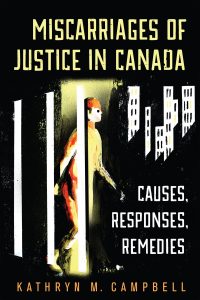
Miscarriages Of Justice In Canada examines phenomena that occur over and over in criminal courts: unreliable witnesses, sloppy police work, indifferent prosecutors. Not every defendant has the good fortune of appearing before a Judge Green. “It is a highly imperfect system,” writes author Professor Kathryn Campbell of the University of Ottawa’s Department of Criminology.
Campbell’s work is meticulous and jarring. Miscarriages Of Justice counts scores, even hundreds of cases of wrongful conviction annually in Canada typically due to witness misidentification, “problematic police investigation,” failure of Crown prosecutors to disclose evidence, fabricated testimony, unreliable jailhouse informants, Court errors, false confessions, prejudice and poor lawyering.
The actual number of wrongful convictions is not known. Campbell identifies at least 32 cases in which Canadians were compensated after being jailed for crimes they did not commit. One victim, Clayton Johnson of Shelburne, N.S., was paid $2.5 million for spending five years in prison on allegations he murdered his wife. Investigators determined Mrs. Johnson fell down the basement stairs while Mr. Johnson was at work.
“Existing laws and evidentiary procedures are presumed to be in place to protect everyone, yet, regardless, errors frequently occur throughout the criminal justice process from investigation, arrest and trial all the way through sentencing,” notes Professor Campbell.
Miscarriages Of Justice concludes officialdom alone is not to blame. Media representation of lawlessness “exerts enormous pressure on the police to solve these crimes, and to do so expeditiously,” writes Campbell. “While public pressure to solve a crime immediately does not always result in the wrong person being accused or convicted, police may, in their desire to solve these cases, cut corners in investigative practices.”
Perhaps. It is also true that journalists, police, prosecutors, defence lawyers and judges are never fired for participating in wrongful convictions through incompetence, indifference or malice. No party to the Dufferin Mall prosecution suffered the loss of a penny’s worth of pensionable earnings let alone seven months in jail.
Miscarriages Of Justice is a darkly compelling book not because it is sensational, but because it is so matter of fact.
By Holly Doan
Miscarriages of Justice in Canada: Causes, Responses, Remedies, by Kathryn M. Campbell; University of Toronto Press; 544 pages; ISBN 9780-80209-4063; $40.76
Count Homes For Immigrants
Canada needed nearly 82,000 homes to shelter new landed immigrants let into the country last year, says the Department of Immigration. The figure was equivalent to more than a third of all new urban housing starts in 2025: “Immigration affects housing.”
Don’t Like Camping At $15M
Parks Canada installed hundreds of small cabins at the equivalent of more than $57,000 apiece to encourage overnight visits by people who don’t like camping, says an internal audit. Recordkeeping was so poor it was impossible to learn if the agency recovered its costs: “Further exploration of operational and capital costs will be needed.”
Media Plead To Keep Subsidy
Government-paid publishers are petitioning MPs to maintain annual payroll rebates worth up to $29,750 per newsroom employee. The rebates, initially promised to be temporary, are set to roll back to $13,750 by year’s end: ‘Reward those who maintain newsroom employment.’
Proposes Trillion-Dollar Plan
Prime Minister Mark Carney yesterday proposed a trillion-dollar expansion of the power grid but would not say who would pay for it. Analysts have warned of substantially higher costs for ratepayers: “Get it wrong and Canadians will pay higher utility bills.”
Claim Hundreds Of Reprisals
Hundreds of Muslims in Canada have faced workplace discipline over their political views, says a Department of Justice report. The figure was attributed to an advocacy group: “Individuals have experienced job loss.”
Told China Of “Mass Grave”
Foreign Minister Anita Anand’s department in private talks with Chinese authorities said it regretted the “mass grave at the former Kamloops Indian Residential School,” Access To Information records disclosed yesterday. “Canada strongly urges China not to repeat Canada’s past mistakes,” said one memo.
Lawsuit Fundraiser Fell Short
A former Canadian Human Rights Commission appointee has fallen short in his bid to raise $200,000 through crowdfunding to finance multiple defamation suits. Records showed Birju Dattani struggled to raise less than a quarter of the amount $50 and $100 at a time, including one donation under the name of a retired MP: “These are tough times.”
CBC-TV Defies Budget Office
CBC managers will not tell the Budget Office how they plan to spend an extra $150 million added to their 2026 budget, records show. The additional funding raises the Crown broadcaster’s annual parliamentary grant to a record $1.6 billion this year: “Abuse of taxpayer dollars when Canadians are struggling for financial survival has contributed to the ‘defund the CBC’ movement.”