
The Commons finance committee today is expected to open hearings into corporate tax avoidance through offshore accounts. Liberal MPs have called the hearings a bid to “dig dirt” on Prime Minister Mark Carney who benefited from Bermuda tax shelters as chair of Brookfield Asset Management: “They dig dirt on day one.”
StatsCan Disciplines 72 Staff
Statistics Canada disciplined 72 employees for misconduct last year including 15 who were fired, according to first-ever disclosure of wrongdoing in the workplace. The agency counted another 21 complaints of harassment and 31 cases of lost or stolen taxpayers’ property, mainly cellphones and laptops: “Everyone is responsible for fostering an ethical workplace.”
Finds Suppliers Game System
Unnamed contractors appear to be gaming the federal system by bidding low on tenders with ambiguous wording to take advantage of revisions at escalating costs, says Procurement Ombudsman Alexander Jeglic. He called it “bid low, let it grow.”
Protest Mandatory Beer Label
Small independent brewers face steep costs under a Senate bill mandating cancer labels, says a lobby group. The private bill would compel all packaging to carry warnings of health risks: “I have never met anybody who thought beer was health food.”
Threaten Jail For “Denialism”
Canadians face jail for “justifying the Indian Residential School system” under a Commons bill introduced by New Democrat MP Leah Gazan (Winnipeg Centre). The maximum penalty is needed to “end Residential School denialism,” said Gazan.
Poem: ‘Get Tough On China’
Poet Shai Ben-Shalom writes: “A guy bigger than me comes my way…”
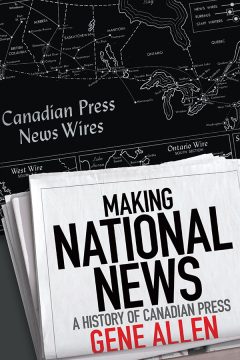
Review: Circus But No Big Top
Professor Gene Allen has compiled a history of The Canadian Press from a corporate secretary’s perspective. I didn’t think that was possible. Writing about a newsroom without the people is like writing about the circus without the big top.
Making National News covers ground already ploughed in The Story Of The Canadian Press, a 1948 account by former CP president Mark Nichols of the Winnipeg Tribune. Neither is compelling.
The story of any organization – a newsroom, a box factory, a daycare centre – is the story of humans. Allen, a professor of journalism, appears to miss the point. The result is predictably lifeless. An example is his story of Jack Best.
Now retired in Ottawa, Best was CP’s man in the USSR in the mid-1960s. He’d have fascinating anecdotes of missile parades, the toppling of Khrushchev, the every-day dysfunction that inspired dark Soviet humour: What’s one kilometre long and eats cabbage? The lineup outside the meat shop.
Allen does not appear to have interviewed Jack Best. Instead he pulled his material from the corporate minutes: “In 1964, CP sent Jack Best, a reporter from the Ottawa bureau who had done well on previous international assignments, to Moscow. Although Best was described as a ‘resident correspondent’, the executive committee did not see this as a long term commitment – it was initially supposed to end by May 1965, then extended to until May 1966. After 18 months, it was decided to keep the bureau open indefinitely. The cost of keeping Best in Moscow was the main element in a $40,000 increase for international coverage in the 1966 budget.”
There you have it, an eyewitness account of the Cold War reduced to a line item in the annual budget.
As the country’s first truly national news agency, CP was born as a wartime propaganda arm of the Government of Canada. They kept it afloat from 1917 to 1923 with a $50,000-a year subsidy, a huge sum at the time but a fraction of federal funding the agency draws today..
Canadian Press’ first war correspondent was a former police reporter named Tom Lyon. When Lyon died in 1946 obituary writers insisted he “saw firsthand” the combat on the Western Front. “Possessed of an almost fanatical desire to get the facts, he tramped many weary miles to see things for himself,” the Globe recalled.
This was untrue. Lyon covered the Battle of Vimy Ridge from his desk in London. He was, however, so adept in the boardroom that in 1934 he was Liberal appointee as the $10,000-a year chair of the Ontario Hydro Commission. It was good work in Depression years when CP was cutting reporters’ pay. These anecdotes are not to be found in Professor Allen’s book.
Canadian Press matured. In its heyday it set a standard for crisp news copy and coverage of the remotest corners of Canada. For generations it was a source of $10 cheques for small town stringers who’d call in copy on a local murder trial or hotel fire.
Newsrooms once were so lively, so dysfunctional, so ego-driven, it would be unimaginable to strip the experience of its humanity. Gene Allen found a way.
By Holly Doan
Making National News: A History Of Canadian Press by Gene Allen; University of Toronto Press; 218 pages; ISBN 9781-4426-15328; $34.95

Plan In Case Of War: “Leave”
The Canadian Coast Guard has orders to avoid all military conflict though it’s now under military supervision, a senior officer yesterday told MPs. “If there were anything, we leave,” testified Deputy Commissioner Marc Mes.
Call Security Bill Dangerous
Free speech advocates yesterday urged the Commons public safety committee to rewrite a cybersecurity bill. The measure would allow the industry minister to block any individual’s internet access by secret order: “That’s dangerous.”
Immigration Figures Delayed
An updated Immigration Levels Plan due to be tabled in Parliament today will instead be delayed until budget day, Immigration Minister Lena Diab yesterday told MPs. It is the first plan to be tabled since the Prime Minister said the system was broken: “There are limits.”
Army Chief Sorry For Racism
Chief of Defence Staff General Jennie Carignan yesterday apologized for racism in the army, navy and air force. “We failed,” she said.
Arab Canadians Near 800,000
The nation’s Arab population numbers nearly 800,000 with the majority foreign born, Statistics Canada said yesterday. Montréal was home to the largest Arab community: “Over one quarter of Arabs in Canada, 27 percent, were children.”
“Surge” Of Misconduct Cases
The Public Sector Integrity Commissioner says she needs triple the number of staff lawyers to handle growing complaints of wrongdoing by federal managers. A “surge of submissions” left a backlog of hundreds of whistleblower complaints alleging misconduct and corrupt practices: “Cases are being delayed.”
Outlook Grim Says Macklem
Bank of Canada Governor Tiff Macklem yesterday reversed a year’s worth of forecasts in acknowledging a recession is possible and may already be underway. His comments followed a Monetary Policy Report that warned Canadians should anticipate a lower standard of living: “Our standard of living as a country, as Canadians, is going to be lower.”
China A ‘Partner, Not Rival’
A Liberal-appointed Senator last March attended meetings in China that “stressed the need to view each other as partners, not rivals,” according to a report tabled yesterday in the Senate. It came only days before Prime Minister Mark Carney called China the biggest threat to national security: “China, you say?”