
Dozens of federal employees logged thousands of hours on the ArriveCan app despite the hiring of 32 contractors at a $59.5 million charge, new records show. The Canada Border Services Agency said staff logged 134,000 hours on the program it falsely claimed had saved lives: “It was value for money,”
Warning Of Another IT Fiasco
Canadian shippers are pleading with cabinet to delay the May 13 launch of a digital Customs collection scheme already 42 percent over budget. “If it launches and launches poorly this will land on the government’s feet because they have been warned,” Conservative MP Kyle Seeback (Dufferin-Caledon, Ont.) told the Commons trade committee.
Pass Bills They Hadn’t Read
Finance Minister Chrystia Freeland provoked outrage Friday after asking senators to pass a budget bill they hadn’t read. Senate managers sought approval to spend another $8.9 billion without disclosing the legal text of the bill: “This is not the first time.”
15-Year Tax Probe Ends In Jail
One of Canada’s longest running tax investigations has ended in a Brampton, Ont. court. The partner in a costly charity kickback scheme was jailed three years: “Most agree it is important that everyone pays their fair share of taxes.”
A Poem: “Species At Risk”
I consider running
for office.
A white,
male,
openly heterosexual.
What are
my chances?
By Shai Ben-Shalom

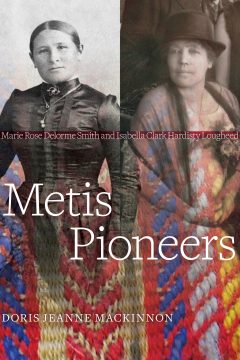
Review: Conflict & A Family Tree
Any history of racial politics of the Victorian era is alive with booby traps for reckless pundits. Were colonists hardy survivors or plain bigots? The historical record is riddled with trigger wires. Researchers are left with fragments of paper. No eyewitness is available for questioning.
Dr. Doris Jeanne MacKinnon, a Red Deer historian, takes the field with Metis Pioneers, a thoughtful account of interracial politics in an era where serious people ascribed characteristics to blood lines for humans and cattle alike. Society manufactured a descending scale of racial superiority. Indigenous women were always at the bottom.
Metis Pioneers chronicles compelling biographies of Victorian women on the Prairies. The reader is guided pleasantly along by MacKinnon’s meticulous research – until. Time freezes on page 125. The gentle lead-up makes it all the more arresting. MacKinnon is a scholar, not a headline writer for the Police Gazette.
Peter Lougheed’s grandmother was Métis. The late Alberta premier rarely spoke of the fact, but too much can be made of this omission. Lougheed never mentioned his alcoholic father, either. He was a man of the pre-Clinton era when politicians considered it cloying and pathetic to weep softly in public and mutter I-feel-your-pain.
MacKinnon’s research suggests Lougheed did not really know his grandmother, Isabella Clark Hardisty Lougheed. He was 8 when she died in 1936. Lougheed recalled her as a remote figure who lived in a mansion and once made a cutting remark that Peter had the same name as the family dog.
Isabella was undeniably Métis. “Her racial features confirmed her ancestry,” write the author. She neither denied nor celebrated her roots, instead cultivating “the persona of the gracious woman.” Historian MacKinnon describes her as a member of the fur trade aristocracy, the niece of one senator, wife of another, grandmother to a premier. Isabella Lougheed attended private schools, traveled by chauffeured limousine and lived in a sandstone mansion that still stands in Calgary, the Beaulieu National Historic Site.
The Prairies then and now was an egalitarian society. It was no scandal to marry for love. Isabella was simultaneously a Daughter of the Empire and a member of the Alberta Pioneer Association where they enjoyed moose steak and the Red River Jig.
Yet racial divisions were unmistakable. Métis had no legal standing. First Nations could not even vote. Author MacKinnon notes Grandmother Lougheed left no diary. Her deepest thoughts are unknown. Was she brave or conflicted, victim or champion, feminist or poseur?
Then, the jaw-dropping moment on page 125. MacKinnon uncovers a rare interview Isabella gave a Toronto newspaper reporter in a feature on prominent ladies of the West. “In Calgary’s early days it was almost impossible to get help,” said Lougheed. “The squaws and half-breed women were all that were available. They could wash but not iron, and they were never dependable.”
Here Lady Lougheed becomes a Métis heroine to break your heart. Her remark was gratuitously stupid, yet perhaps judgment is too harsh. Isabella was not the one to starve First Nations or mandate the celebration of Empire. It doesn’t fall to everyone to be Nelson Mandela.
“The interview provides a rare example, in Isabella’s own words, of her own management of her public image,” writes MacKinnon; “This is the one and only time we know for certain she had Indigenous women in her grand home in Calgary, and she took the opportunity to let her new community know what she thought of ‘squaws’ and ‘half breeds’.”
Metis Pioneers is a compelling journey through the Victorian minefield of race and politics. It works.
By Holly Doan
Metis Pioneers: Marie Rose Delorme Smith and Isabella Clark Hardisty Lougheed, by Doris Jeanne MacKinnon; University of Alberta Press; 584 pages; ISBN 9781-77212-2718; $45
Internet ‘Frankly Terrifies Me’
Attorney General Arif Virani yesterday said the internet “frankly terrifies me.” Virani defended a federal censorship bill even Liberal MPs questioned as far-reaching: “We need to make the internet safe.”
Minister Won’t Explain Photo
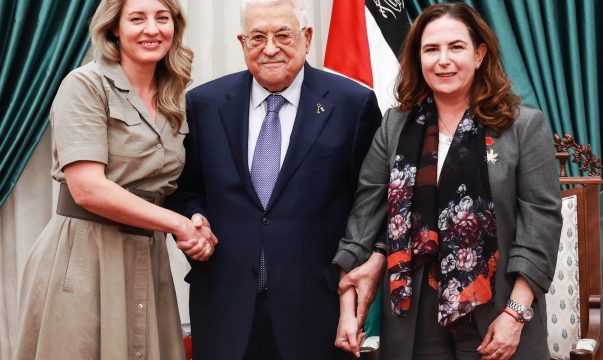
Addictions Minister Ya’ara Saks yesterday bristled over criticism over her posing in an official photograph by holding hands with a Holocaust denier, Palestinian Authority President Mahmoud Abbas. Saks described herself as a proud Jewish Canadian: “I take offence to your comments.”
Labour Warns On C-58 Delay
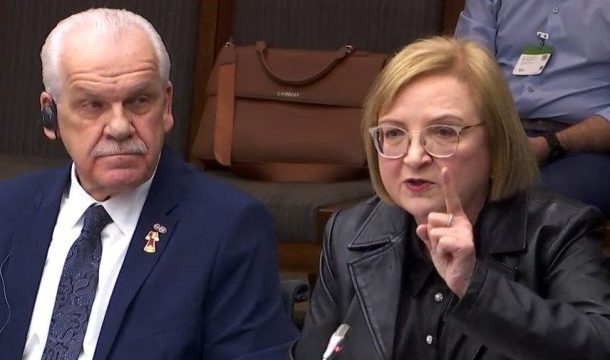
Union executives yesterday asked MPs to rewrite a cabinet bill that delays enforcement of a ban on replacement workers until after the next election. Quick adoption of Bill C-58 was “the very least elected officials can do,” said Lana Payne, national president of Unifor: “Not 18 months from now, not a year from now.”
It Wasn’t Us, Say Ukrainians
The Ukrainian Canadian Congress played no role in a Commons tribute to a Nazi collaborator, the group yesterday told the House affairs committee. Cabinet had blamed the Congress for the incident involving ex-Waffen SS member Yaroslav Hunka: “We had no involvement and never spoke to the Speaker’s office.”
Drug Dealers Still Dangerous
Illegal marijuana dealers remain a danger to public safety six years after Parliament legalized cannabis, a Department of Health panel said yesterday. The statutory review of Bill C-45 An Act Respecting Cannabis said marijuana use among postsecondary students was also worrisome: “We are concerned with the criminal activity that persists.”
House Jeers But No Election
The Commons yesterday rejected a Conservative motion to hold a springtime carbon tax election. The vote on the non-confidence motion followed a raucous, day-long debate: “You have completely lost it, Kevin.”
Feds Tighten Migrant Hiring
The Department of Employment yesterday tightened migrant hiring as new figures showed 766,520 temporary foreign worker permits were issued last year. The number was in addition to 982,880 foreign students able to work in Canada and a general immigration quota of 465,000: “We know it’s time to ease our reliance on foreign workers.”
CEO Lied, Must Return: MPs
Catherine Tait, the $497,000-a year CEO of the CBC, lied to Parliament in finagling a budget hike and millions in bonus money for executives, say members of the Commons heritage committee. MPs voted 6-5 to summon Tait for questioning by April 9: “Miss Tait actually lied.”
Confirm Federal Fraud Rings
Public Works Minister Jean-Yves Duclos yesterday confirmed millions were stolen through double-billing by federal subcontractors over a period of four years. “We need to do better when it comes to ensuring the integrity and reputation of our procurement system,” he told reporters: “This is a troubling outcome.”