Oil companies should pay costs of wildfires, a New Democrat yesterday told the Commons. MP Charlie Angus (Timmins-James Bay, Ont.) said it was unfair to charge firefighting expenses to taxpayers since oil companies were “burning the planet.”
Find Tax Cheating ‘Prevalent’
Tax evasion is “prevalent” in high priced real estate markets, says in-house research by the Canada Revenue Agency. An Agency report concluded tax cheating was commonplace and deliberate: “Non-compliance in real estate is prevalent throughout Canada and is likely more widespread than many are aware of.”
Ethics Complaints Against 11
A four-month vacancy at the Office of the Ethics Commissioner left a backlog of complaints, Interim Commissioner Konrad von Finckenstein said yesterday. Von Finckenstein said reviews are pending on allegations against 11 public office holders he would not name: “Let’s not pussyfoot around.”
Tells Them To Call City Hall
Canadians without adequate housing should call City Hall, Housing Minister Sean Fraser said yesterday. Fraser acknowledged it will take years to build enough homes to meet demand nationwide: “What people who are sleeping rough today need to do is contact local authorities.”
MPs Consider TMX Toll Hike
Trans Mountain Pipeline operators must consider increasing tolls to limit mounting taxpayer losses on the project, the Commons natural resources committee said yesterday. MPs in a report said a huge loss appeared unavoidable: “The pipeline operator may be unable to charge high enough tolls to cover the costs.”
Seek Repeal Of Flaherty Cuts
Canada’s largest public sector union is petitioning MPs to repeal federal corporate tax cuts by former finance minister Jim Flaherty. Repeal is worth billions a year, said the 715,000-member Canadian Union of Public Employees: “These cuts have left a huge hole in federal budgets.”
Allegation Shocking ‘If True’
Cabinet yesterday ordered an Indian diplomat out of the country over allegations of official ties to the killing of Hardeep Singh Nijjar, a Surrey, B.C. activist. The claim “if proven true” was grave, said cabinet: “We will seek the truth.”
Newspapers Want More Cash
The newspaper lobby is demanding its $595 million “temporary” bailout be extended with double the federal subsidies. “Address this,” lobbyist Paul Deegan, CEO of News Media Canada, wrote MPs: “The financial situation for most news publishers is extremely challenging.”
Broke Promise, Hikes EI Rates
Cabinet is hiking Employment Insurance premiums by $1.4 billion despite a promise by Finance Minister Chrystia Freeland that rates would be “holding steady.” Freeland in her March 28 budget promised “more money in Canadians’ pockets after a hard day’s work.”
‘Stall Home Prices,’ MPs Told
Parliament must “require home prices to stall” since inflation mainly benefits longtime homeowners over 55, a CMHC-sponsored group wrote MPs. The Prime Minister last Wednesday said “house pricing cannot continue to go up” but stopped short of advocating price controls: “It’s not fair.”

Claim 6,000,000 Conspiracists
About 15 percent of Canadians, as many as six million people, are conspiracy theorists, says a federally-subsidized media monitor. The Canadian Anti-Hate Network says it requires more subsidies to counter those who would “do away with our liberal democracy.”
Reject Blocks On Slave Goods
Anti-China slavery groups have lost a legal challenge to force federal agents to seize products made by forced labour. The Federal Court of Appeal said human rights advocates could not sue on principle, alone: “Our enforcement to this point has been terrible.”
A Poem — “Making History”
U.S., Cuba
restore ties.
Canada claims
credit.
We were the
host, the facilitator,
the neutral
ground.
Let no one
think
the former foes
could have done
it without us.
Meanwhile, in
Ottawa,
discussions are
in high gear
to select an
adequate site
for the
National Memorial to Victims of
Communism.
By Shai Ben-Shalom

Review: Winning The Blame Game
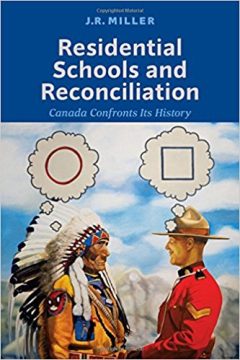
In Canada’s tortured postwar history of “reconciliation” with Indigenous people not a single deputy minister has been called to the witness stand. That’s odd. There have been twenty of them since 1953, yet blame for repeated failures was pinned on churches, social workers, Indian Residential School superintendents, the police or Canadian society as a whole. When everybody is to blame, nobody is to blame.
Professor Jim Miller of the University of Saskatchewan pulls back the curtain on the historical blame game. Residential Schools And Reconciliation documents Ottawa’s handling of Indigenous issues. This is not ancient history. It just happened.
Methodically, step by step in infuriating detail, Miller recounts the costly failures, a “pettifogging” dispute resolution system and bureaucratic cross-piling of sawdust that left Canadians with a process that satisfied no one.
“It was easier to blame the students for the shortcomings of the schools than to face up to the reality that the system the Canadian government and the churches had created was not succeeding,” writes Miller.
The system began unraveling in 1993 when pedophile William Starr, former supervisor of an Indian Residential School at Gordon, Sask. northeast of Regina, was jailed for sexual assaulting students. Originally run by the Anglican Church, the Gordon School was taken over by the Department of Indian Affairs in 1969. This spelled federal liability. The Gordon facility was the last Residential School to close, in 1996.
Starr’s crimes triggered cascading disclosures that led to official apologies, hundreds of millions in payments to entrepreneurial law firms, compensation for students and a succession of inquiries that carefully avoided any direct connection to headquarters back in Ottawa.
The Department of Indian Affairs had “a long history of deciding things for rather than with First Nations people,” writes Miller. He recounts the experience of one civil servant, Shawn Tupper, assigned to the Residential School issue in 1996 following the Gordon scandal.
“The government’s position concerning the schools had evolved little over the previous half-century,” notes Residential Schools And Reconciliation. No one had even talked to students. Tupper thought it might be a good idea to go “into the field and talk to people who had been affected.”
Residential Schools And Reconciliation cites indelible vignettes. How should Ottawa and the churches split liability: fifty-fifty? Sixty-forty? Seventy-thirty? Should churches apologize or merely issue statements of repentance on advice of legal counsel?
How might officialdom handle degrading spectacles, where claimants for compensation would “have to answer questions about where the priest put his finger or penis, how many times, how they felt, and so on”? What if Indigenous boys and girls attended day school, not boarding school – did that count?
Through all of it, successive deputy ministers were held blameless. No names were named. Crimes were ascribed to an unfortunate colonial culture.
In the name of reconciliation, the Royal Winnipeg Ballet received a $50,000 grant “to help develop a new ballet that was based on the stories that had been recounted by survivors at the various meetings of the Truth and Reconciliation Commission.” It “enjoyed a short run”, writes Miller.
Not official reconciliation, however. This will be with us for a long, long time.
By Holly Doan
Residential Schools and Reconciliation: Canada Confronts Its History, by J.R. Miller; University of Toronto Press; 348 pages; ISBN 9781-4875-02188; $39.95
Prefers Nova Scotia Livestyle
Governor General Mary Simon logged thousands of kilometres by government jet to live in Nova Scotia rather than the 175-room Rideau Hall mansion in Ottawa. Simon yesterday disclosed she decided to make Nova Scotia her home “during the pandemic.”