
Housing department staff in an Access To Information memo to Minister Gregor Robertson complained of the trouble and expense in opening a new office in Toronto or Vancouver. Rents were too high, they said: “There is a 3 to 4 year wait time.”
Hired Gender Equity Analyst
The Canadian Armed Forces spent tens of thousands on a “gender equity” analysis of housing while failing a federal audit as a bad landlord, records show. The hiring of a “social inclusion advisor” was among contracts approved by the military’s Housing Agency: “Are you a business or organization looking to build your awareness on equity?”
Count 160-Year Gas Supply
Canada has a 160-year supply of natural gas that will be worth a fortune in a tightening global market, says the Department of Natural Resources. The forecast came as senators were urged to endorse a clause in cabinet’s omnibus budget bill that would permit 50-year liquefied gas export permits: “The 1,100,000,000,000,000 cubic feet is just representative of what is in the West.”
Tax Bill Of Rights Is No Help
Taxpayers out of pocket for bad advice from the Canada Revenue Agency should file a complaint under the Taxpayer Bill Of Rights, say managers. Federal judges previously ruled the document is not a bill and does not convey any rights: “It would probably be better if the document were given a different name.”
Reno Took 10 Years & $132M
Parks Canada spent more than $131 million renovating Charlottetown’s Province House, records show. The home of the Prince Edward Island legislature has been closed for 10 years: “It’s like everything else in life. They left the big repairs until they needed doing.”
The Sunday Poem —
We would love to take credit for the fact we all share but then we wouldn’t, now would we? We would love to take credit for the indelible likeness of Marilyn Monroe and be to blame for all bad things. We would love to say sorry; be absolved.
We would love to say sorry and mean it, in the phone bill and the army telegram. We would love to bestow contentment unto yawl and a resign drawl shawled o’er each command. We would love to say sorry; be absolved.
We would love to release almost all our agents, and eventually the rest. We would love to whisper sorry in the ears of babes, render horrors pastoral; the chicken’s neck clean to the blade. We would love to say sorry; be forgave.
By Jeff Blackman

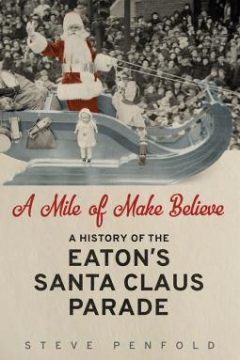
Review: Eaton’s & The Alligator
In the days before television, newsreel producers each year assigned cameras to film three visually rich, set-piece spectacles that represented Canada to theatre audiences nationwide: the opening of Parliament, the Calgary Stampede and the Eaton’s Santa Claus parade. One of these is gone.
A Mile Of Make Believe recounts with warmth and nostalgia the Christmas extravaganza sponsored by a family-owned corporation once the largest retailer in the country. This is not a dry municipal history. Eaton’s in its heyday sponsored Santa parades from Edmonton to Montréal. Author Steve Penfold, an associate professor at the University of Toronto, has crafted a smart and funny account of a lost piece of Canadiana.
Nobody did more than Eaton’s to take the Christ out of Christmas. “The Santa Claus parade was a spectacle of capitalist non-realism,” writes Penfold. Organizers specifically excluded religious imagery. If the 1920 parade featured Noah’s Ark, the star of the float was a monkey smoking a pipe. Penfold recounts an incident at the 1968 event when an elderly protester shouted, “This is not a parade for God, this is a parade for the devil.” One mother replied: “For crying out loud, will you shut up.”
Eaton’s did not invent the Santa parade. A Mile Of Make-Believe traces the roots of the retail observance to a local department store sponsorship in Peoria, Illinois in 1888. Yet none eclipsed Eaton’s in scale or scope. It was “an assault on the eyes and ears,” writes Penfold. One Toronto parade featured a Mother Goose float that filled half a city block. The Montréal parade was fronted by the military band for the Black Watch pounding out Jingle Bells.
“The company expended stunning resources on the events,” says Penfold. “By the 1950s, the parade ate up more than half the company’s public relations budget,” the equivalent of $1.3 million at its peak.
“As a corporate spectacle that experienced its golden years in the middle decades of the twentieth century, the Eaton’s Santa Claus was one example of a powerful new form of commercial life and culture holiday – the Christmas pageant,” the author notes.
The producer of the longest-running Toronto spectacle was Jack Brockie. He joined Eaton’s in 1914 and for decades ran a year-round team of carpenters and seamstresses preparing for the Christmas wonder. Brockie was the “man in the grey flannel suit with an eye for colour” and a love of children. “Every year I go along University Avenue and look at the expressions on their faces – white faces, black faces, yellow faces, along together for their Santa,” Brockie wrote a friend.
A Mile Of Make-Believe is also an affectionate tribute to a corporate giant. In 1969 the company had 48 stores and a payroll of 50,000 employees, the fourth-largest employer in Canada. Eaton’s ran purchasing offices in London, Paris, New York, Yokohama and Kobe. As late as 1975 it remained the largest retailer in Canada, eclipsed only by Hudson’s Bay the following year.
It ended pathetically. Eaton’s dropped its parade sponsorship as an austerity measure in 1982 and collapsed in bankruptcy in 1999. We are left with memories and newsreel images of blaring bands and a fifty-foot alligator slithering down University Avenue.
By Holly Doan
A Mile of Make-Believe: A History of the Eaton’s Santa Claus Parade, by Steve Penfold; University of Toronto Press; 256 pages; ISBN 9781-4426-29240; $27.95
“Merry Christmas” Defector
Rookie Conservative MP Michael Ma (Markham-Unionville, Ont.) last night abruptly defected to the government caucus, bidding his newfound Liberal colleagues a “merry Christmas.” The floor-crossing was announced as the Commons adjourned for a six-week recess: “Happy holidays and a great 2026.”
Confirms A Second Post Loan
Canada Post is seeking a second emergency loan from cabinet and will require years to pay back more than a billion already borrowed, CEO Doug Ettinger yesterday told MPs. An initial $1,034,000,000 line of credit approved last January 24 has run out, the Commons government operations committee was told: “We’ve exhausted that.”
Gov’t Admits $6.6M Mistake
The Department of Health paid out more than $6.6 million in ineligible claims under its Canada Dental Care Plan, records show. It follows disclosure the overall cost of the program is projected to go 50 percent over budget this year: “An error was identified.”
Missing Art Included Jewelry
Artworks that vanished from a multi-million dollar federal collection included jewelry, records show. The Department of Crown-Indigenous Relations said jewelry disappeared from an unnamed regional office 30 years ago but was only made public now: “Have you contacted police?”
Got Raise Under Investigation
Cabinet approved a five-figure pay raise for an appointee under investigation for workplace misconduct, records show. Marie Chapman of Bedford, N.S., CEO of the Museum of Immigration, yesterday was accused of office bullying like referring to employees as “sluts.”
Plans Outreach On Quran Bill
Attorney General Sean Fraser says he will spend the winter consulting faith leaders on a proposal to prohibit hate speech under the pretext of religious instruction. It follows a 2023 incident in which a Montréal activist called for death to Jews while reading a Quran prayer: “There’s a number of faith leaders who’ve reached out.”
Most Ignored Travel Directive
Most federal agencies spent more, not less, on travel last year while cabinet claimed to save taxpayers’ money, new records show. Then-Finance Minister Chrystia Freeland promised a 15 percent reduction in travel spending as proof the government was “fiscally responsible.”
Foreign Study Was Bonanza
Colleges in a single province made a fortune in fees on foreign students, Statistics Canada confirmed yesterday. Record enrollment by foreigners made Ontario the only jurisdiction in Canada where colleges raised more in tuition than they required in public funding: “Nothing lasts forever.”



